
Blog

How Backgauge Technology Improves Precision in CNC Press Brake Bending
Accuracy is everything in metal fabrication. Whether you are shaping components for automotive applications, creating heavy-duty industrial parts, or designing complex sheet-metal structures, precision determines product quality, consistency, and customer satisfaction. Among all metal-forming technologies, press brake bending stands out as one of the most widely used processes — and the introduction of advanced backgauge systems has transformed the capability of modern bending equipment.
Today, the latest CNC Press Brake Machine and Hydraulic Press Brake Machine models are built with highly responsive, multi-axis backgauge systems that ensure exact positioning of metal sheets before every bend. This innovation has significantly reduced operator errors, improved repeatability, and increased the overall speed of manufacturing.
In this blog, we explore how backgauge technology works, why it is essential for precision bending, and how modern CNC technology elevates performance across different press brake types — especially machines such as the Front Cylinder Press Brake Machine and high-performance shearing units like the CNC Hydraulic Shearing Machine.
What Is Backgauge Technology?
Contents
- 1 What Is Backgauge Technology?
- 2 Why Precision Matters in CNC Press Brake Bending
- 3 How Backgauge Technology Works in a CNC Press Brake
- 4 Multi-Axis Backgauge Systems and Their Benefits
- 5 Backgauge Technology in Hydraulic Press Brake Machines
- 6 Role of Backgauge Technology in Front Cylinder Press Brake Machines
- 7 Integration With CNC Hydraulic Shearing Machines
- 8 How Backgauge Technology Improves Productivity
- 9 Modern Features That Enhance Backgauge Performance
- 10 Future Trends in Backgauge Technology
A backgauge is a positioning tool mounted behind the bending area of a press brake. It acts as a reference point for placing sheet metal accurately before the bend is executed. When the operator slides the workpiece toward the gauge, the metal stops at a predetermined distance, ensuring perfect alignment every time.
Modern backgauge systems are motorized, servo-controlled, and fully integrated with CNC software. This allows operators to:
- Input precise measurements through the control panel
- Automate complex multi-stage bending
- Maintain consistent bending angles and flange lengths
- Reduce manual adjustments and operator dependency
Instead of relying on physical rulers, chalk marks, or guesswork, the backgauge provides digital accuracy that enhances the capability of modern equipment, especially a CNC Press Brake Machine.
Why Precision Matters in CNC Press Brake Bending
Precision in bending operations is crucial for several reasons:
Dimensional Accuracy
Small deviations can compromise the assembly of the final product. Backgauge systems ensure consistent flange lengths for flawless fitting.
Improved Repeatability
Once programmed, the CNC controls repeatedly create identical bends — a major advantage for mass production.
Reduced Material Waste
Precision reduces rework and eliminates scrap generated from inaccurate bends.
Time Efficiency
Automated alignment minimizes operator intervention, speeding up the entire bending process.
Better Product Quality
Tighter tolerances and smoother bending create a higher-quality finished result.
With the demand for tighter tolerances in industries like electronics, aviation, furniture, and machine manufacturing, backgauge technology is no longer optional — it is essential.
How Backgauge Technology Works in a CNC Press Brake
The strength of backgauge technology lies in its integration with CNC systems. Here is how it improves precision step-by-step:
Step 1: Program Input
The operator enters parameters such as bending angle, flange length, metal thickness, and tooling setup into the CNC controller.
Step 2: Automatic Positioning
Servo motors move the backgauge into the correct position, aligning the sheet metal precisely for the first bend.
Step 3: Sheet Positioning
The operator slides the sheet against the backgauge fingers. The CNC system ensures perfect alignment before the ram begins its downward motion.
Step 4: Multi-Bend Automation
For complex parts requiring multiple bends, the backgauge automatically adjusts after each bend, eliminating manual repositioning.
Step 5: Real-Time Adjustments
CNC sensors detect bending errors and compensate automatically, ensuring precise output for every cycle.
This process dramatically simplifies operation for even the most complex parts.
Multi-Axis Backgauge Systems and Their Benefits
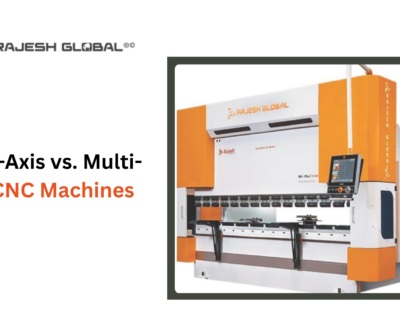
Modern machines such as the CNC Press Brake Machine come equipped with multi-axis backgauge systems, typically ranging from X-axis (forward/backward movement) to as many as 6 or 7 axes, including:
- X-Axis – depth positioning
- R-Axis – vertical movement
- Z-Axis – lateral movement
- X1/X2 and Z1/Z2 – independent finger controls
- Delta Axis – bending angle correction
These systems provide significant advantages:
Complex Bending Made Simple
Multi-axis functions allow for intricate bends without repositioning the workpiece.
Ultra-High Accuracy
Servo-based movement ensures positioning tolerances within microns.
Faster Production
Automated movement reduces cycle times and boosts throughput.
Reduced Operator Training Requirements
Since most functions are automated, even new operators can handle complex jobs efficiently.
Backgauge Technology in Hydraulic Press Brake Machines
Although CNC press brakes are the most advanced, modern Hydraulic Press Brake Machine models also benefit from upgraded backgauge systems. Hydraulic presses require precise control of ram force, and enhanced backgauges ensure that the sheet is positioned correctly before each hydraulic stroke.
Key Advantages in Hydraulic Systems:
- More consistent accuracy
- Improved control during long bending operations
- Enhanced performance for thicker or harder metal sheets
Hydraulic machines equipped with multi-axis backgauges bridge the gap between traditional and CNC bending technology, making them reliable for heavy-duty industrial applications.
Role of Backgauge Technology in Front Cylinder Press Brake Machines
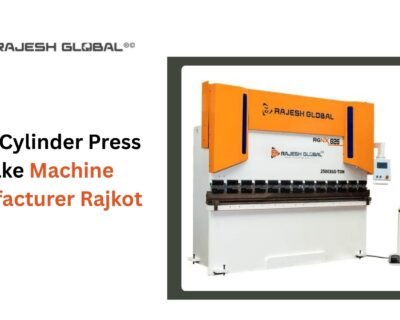
A Front Cylinder Press Brake Machine has cylinders positioned at the front of the frame, offering better ram balance and improved bending accuracy. When combined with a multi-axis backgauge system, this setup offers:
- Higher rigidity during bending
- Reduced deflection across the length of the bed
- Better performance in long or wide sheets
- Improved parallelism between the die and punch
This machine type is widely used in fabrication industries that require both precision and high productivity.
Integration With CNC Hydraulic Shearing Machines
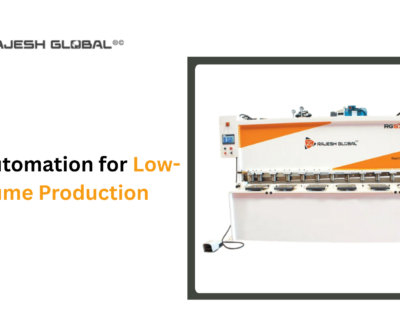
Backgauge technology also plays a vital role beyond bending machines. In a CNC Hydraulic Shearing Machine, the backgauge determines the cutting length, ensuring accurate shearing of sheet metal before it proceeds to the press brake for bending.
Benefits of Backgauge in Shearing Machines:
- Perfect cut lengths
- Reduced rework during bending
- Smoother workflow from cutting to forming
- Better edge quality and consistency
This integration ensures that the entire fabrication line — from shearing to bending — delivers maximum accuracy.
How Backgauge Technology Improves Productivity
Precision is only one benefit. Backgauge automation significantly boosts productivity across sheet-metal fabrication facilities.
Faster Workflows
Manual positioning slows down production. CNC backgauges move quickly and automatically.
Reduced Human Error
Even expert operators make mistakes; automation removes guesswork entirely.
Streamlined Multi-Bend Operations
The system automatically adjusts for second, third, and later bends, saving massive time.
Consistency Across Shifts
Machines deliver identical results regardless of operator skills.
Lower Operating Costs
Less waste, less rework, and fewer rejected parts lower the overall cost per unit.
Modern Features That Enhance Backgauge Performance
Modern bending equipment, including the latest CNC Press Brake Machine, integrates various advanced features to further enhance performance:
- High-precision servo motors
- Touch-screen CNC controls
- 2D/3D simulation software
- Laser-assisted bending monitors
- Automatic angle measurement tools
- Safety light curtains
- High-speed finger movement systems
These enhancements combine with backgauge technology to deliver unmatched precision and productivity.
Future Trends in Backgauge Technology
The evolution of backgauge systems continues rapidly. In the next few years, we can expect:
AI-Driven Bending
Automatic machine learning systems that adjust parameters in real-time.
Smart Sensors
More accurate sensors for thickness compensation, sheet deflection, and bend angle correction.
Fully Autonomous Bending Lines
Robotic arms integrated with CNC press brakes for unmanned production.
Higher Axis Control
Backgauges with 10+ axis systems for extremely complex bending tasks.
Backgauge technology will play a key role in the future of smart manufacturing.
Conclusion
Backgauge technology has completely transformed the way bending operations are performed in modern fabrication. With CNC integration, servo motors, multi-axis control, and advanced sensors, today’s press brakes deliver unmatched precision, consistency, and speed.
From the advanced capabilities of a CNC Press Brake Machine to the reliability of a Hydraulic Press Brake Machine and the efficiency of a Front Cylinder Press Brake Machine, every modern bending solution benefits from accurate backgauges. Even the CNC Hydraulic Shearing Machine relies on this technology for perfect sheet preparation before bending.
For any workshop looking to enhance product quality and scale production, upgrading to a CNC-enabled backgauge system is no longer an option — it is a necessity for staying competitive in the metal fabrication industry.