
Blog
200-Ton Hydraulic Press Machines: Key Features, Uses & Advantages
In today’s fast-paced manufacturing environment, strength, precision, and reliability are non-negotiable. Among industrial machines, the 200-ton hydraulic press machine stands out as a powerful solution for heavy-duty forming, bending, stamping, and pressing tasks. From large fabrication units to advanced CNC-integrated workshops, these machines play a vital role in shaping metal components with accuracy and consistency.
This detailed guide explores the key features, industrial uses, and advantages of 200-ton hydraulic press machines. You’ll also understand how they connect with related equipment such as Hydraulic Iron Worker, CNC Press Brake Machine, and C Frame Hydraulic Press, making them a core asset in modern metalworking facilities.
What Is a 200-Ton Hydraulic Press Machine?
Contents
- 1 What Is a 200-Ton Hydraulic Press Machine?
- 2 Key Features of 200-Ton Hydraulic Press Machines
- 3 Main Applications of 200-Ton Hydraulic Press Machines
- 4 Uses Across Major Industries
- 5 Advantages of 200-Ton Hydraulic Press Machines
- 6 Comparison with Other Press Machines
- 7 Integration with CNC & Automated Systems
- 8 Maintenance & Long-Term Reliability
- 9 Choosing the Right 200-Ton Hydraulic Press Machine
- 10 Future of Hydraulic Press Technology
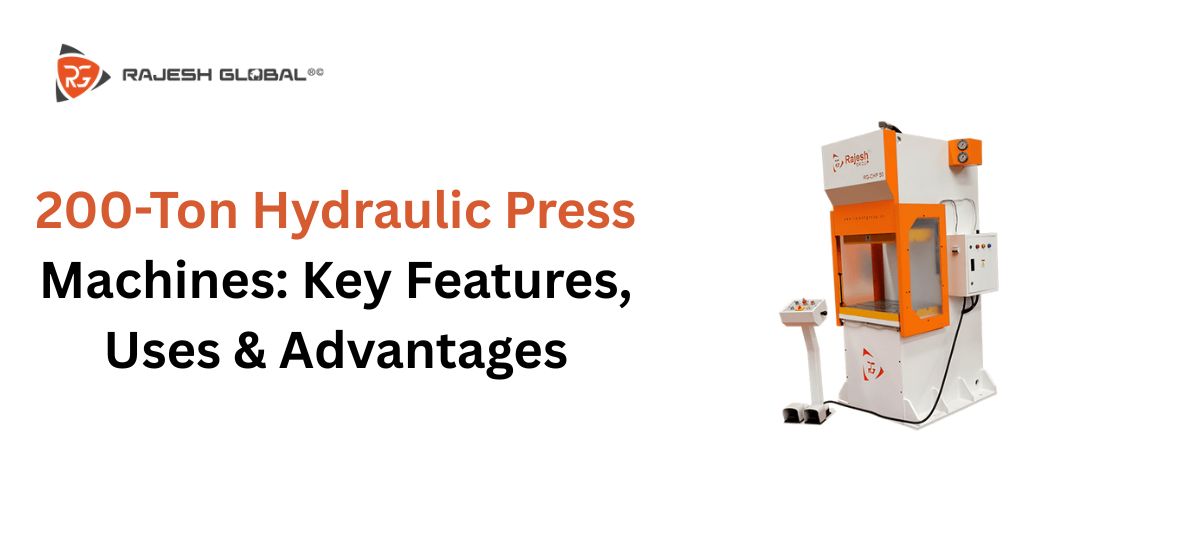
A 200-ton hydraulic press machine is an industrial press that uses hydraulic force to apply up to 200 tons of pressure. This immense force is generated through hydraulic cylinders powered by pressurized fluid, allowing uniform pressure distribution during operation.
Unlike mechanical presses, hydraulic presses deliver full tonnage throughout the stroke. This makes them highly suitable for deep drawing, bending, forming, and straightening operations requiring controlled force.
Key Features of 200-Ton Hydraulic Press Machines
1. Heavy-Duty Frame Construction
Most 200-ton presses feature a rigid steel body designed to withstand continuous high-pressure cycles. Configurations often include straight-side or C Frame Hydraulic Press designs, both offering excellent strength and stability.
2. Advanced Hydraulic System
The hydraulic system ensures smooth pressure application, minimal vibration, and consistent force output. Precision valves and pumps allow operators to adjust pressure as per job requirements, improving safety and quality.
3. Control Panel & Automation Support
Modern machines come with user-friendly PLC or CNC controls. These controls allow operators to monitor stroke length, pressure, speed, and dwell time. Integration with systems like CNC Press Brake Machine workflows becomes seamless.
4. Energy Efficiency
Hydraulic presses consume power only during the pressing operation. Compared to traditional mechanical systems like C Type Mechanical Power Press, this results in better energy efficiency and lower operational costs.
5. Safety Mechanisms
Safety is critical in high-tonnage equipment. These machines include pressure relief valves, emergency stop buttons, two-hand operation systems, and overload protection to prevent accidents and machine damage.
Main Applications of 200-Ton Hydraulic Press Machines
Metal Forming & Bending
Hydraulic presses are widely used for bending and forming metal sheets, plates, and profiles. They work efficiently alongside equipment such as Hydraulic Press Brake Machine for complex bending jobs.
Deep Drawing Operations
Industries manufacturing automotive components, kitchen sinks, and enclosures rely on deep drawing processes made possible by 200-ton hydraulic presses.
Pressing & Assembly Tasks
From bearing fitting to bush installation, these machines ensure accurate pressing without deforming parts.
Plate Processing Industry
In sectors involving Plate – Rolling, hydraulic presses help in pre-forming plates before rolling, improving alignment and final output quality.
Fabrication & Structural Work
Workshops using Hydraulic Iron Worker machines often complement their operations with hydraulic presses for punching, bending, and straightening thick metal components.
Uses Across Major Industries
Automotive Industry
200-ton presses are extensively used for forming chassis parts, brackets, and reinforced panels. Their repeatability ensures consistent quality for mass production.
Sheet Metal & Fabrication Units
Integration with CNC Hydraulic Shearing Machine lines makes hydraulic presses ideal for end-to-end sheet metal processing—from cutting to final finishing.
Heavy Engineering & Infrastructure
Large components for railways, bridges, and industrial machinery require controlled force. Hydraulic presses deliver this without compromising material integrity.
Electrical & Appliance Manufacturing
From motor housings to transformer parts, accurate pressure application is essential. Hydraulic presses deliver precision where mechanical presses may fall short.
Advantages of 200-Ton Hydraulic Press Machines
1. Consistent Full-Tonnage Force
Unlike mechanical presses, full pressure is available at any point in the stroke. This ensures uniform forming and reduces rejection rates.
2. High Precision & Control
Pressure, speed, and stroke can be precisely controlled, which is essential for advanced forming and bending tasks involving Front Cylinder Press Brake Machine setups.
3. Reduced Tool Wear
Smooth hydraulic motion reduces impact stress on tools and dies. This extends tool life and lowers maintenance costs.
4. Versatility in Operations
A single 200-ton press can perform bending, stamping, drawing, and straightening. This flexibility eliminates the need for multiple machines.
5. Lower Noise Levels
Compared to machines like C Type Mechanical Power Press, hydraulic presses operate quietly, improving workplace comfort and safety.
Comparison with Other Press Machines
Hydraulic Press vs Mechanical Power Press
While C Type Mechanical Power Press machines are faster for high-speed blanking, hydraulic presses provide better control, safety, and versatility, especially for complex operations.
Hydraulic Press vs Press Brake Machines
Press brakes such as Hydraulic Press Brake Machine and CNC Press Brake Machine specialize in bending. However, a 200-ton hydraulic press offers broader functionality beyond bending alone.
Integration with CNC & Automated Systems
Modern manufacturing emphasizes automation. 200-ton hydraulic presses integrate smoothly with CNC-based machinery including CNC Press Brake Machine and CNC Hydraulic Shearing Machine systems. This integration improves:
- Production speed
- Dimensional accuracy
- Repeatability
- Reduced human error
Automation also supports data tracking and predictive maintenance, which is crucial for large-scale production.
Maintenance & Long-Term Reliability
Proper maintenance ensures consistent performance and long service life. Key practices include:
- Regular hydraulic oil checks
- Seal and hose inspection
- Pressure calibration
- Control panel diagnostics
When maintained correctly, hydraulic presses outperform many other systems in durability and uptime.
Choosing the Right 200-Ton Hydraulic Press Machine
Before investing, manufacturers should consider:
- Type of application
- Material thickness
- Required automation level
- Compatibility with existing machines like Hydraulic Iron Worker or Front Cylinder Press Brake Machine
Selecting the right configuration improves productivity and reduces future upgrade costs.
Future of Hydraulic Press Technology
With advancements in smart controls, energy-efficient pumps, and automation, hydraulic press machines are evolving rapidly. Smart sensors, IoT-enabled monitoring, and adaptive pressure control are making these machines more intelligent, reliable, and sustainable.
Conclusion
A 200-ton hydraulic press machine is more than just a powerful industrial tool—it is a cornerstone of modern manufacturing. With unmatched force control, versatility, and safety, it supports a wide range of applications across industries. Whether used independently or alongside systems like Plate – Rolling, C Frame Hydraulic Press, or Hydraulic Press Brake Machine, it delivers precision, efficiency, and long-term value.
For businesses aiming to enhance production quality, reduce operational costs, and meet evolving industrial demands, investing in a 200-ton hydraulic press machine is a smart and future-ready decision.